



You know, for a while now, I’ve been fascinated by dreams. Not in a spooky way, just wondering what the heck my brain is cooking up when I’m asleep. I always figured it was just random stuff, but then I started hearing folks talk about AI trying to make sense of it all. Naturally, my ears perked right up.
My journey into this whole AI dream interpretation thing kicked off pretty casually. I was scrolling through my feed one night, probably avoiding doing dishes, and an ad popped up for a “dream analysis app.” My first thought was, “No way, that’s just a gimmick.” But then, the curiosity bug bit me hard. I mean, what if it actually worked? I figured, why not give it a shot? What’s the worst that could happen?
Diving In: My First Forays
So, the next morning, after waking up from a particularly wild dream about chasing a giant pretzel through a library, I decided it was time. I pulled out my phone and actually typed “AI dream interpreter” into the search bar. A bunch of sites and apps popped up, all promising to unlock the secrets of my subconscious. I picked one that looked pretty straightforward, no crazy ads everywhere.
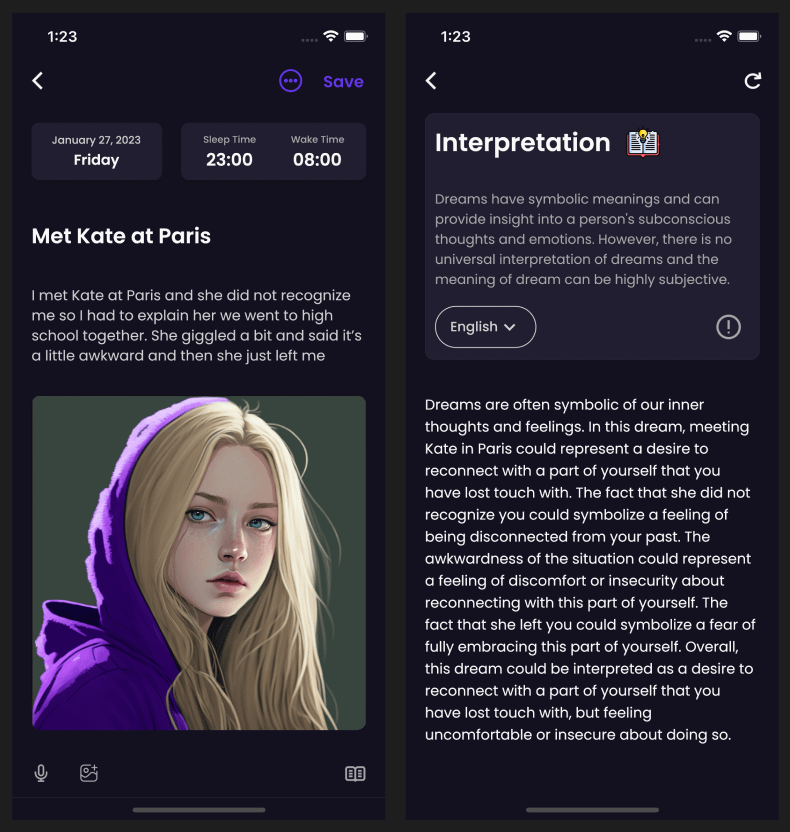
The first thing I did was download the app. It was free to start, which was a bonus. Once it was on my phone, I opened it up, and it asked me to describe my dream. I tried to be as detailed as possible about that pretzel chase. I wrote down the colors of the books, the squeak of my sneakers, the bizarre joy of the whole thing. Then, I hit the “interpret” button.
I waited for a few seconds, genuinely holding my breath. The app crunched some data, I guess, and then a paragraph popped up. It talked about “the pursuit of knowledge,” “unconventional desires,” and “a craving for comfort.” Honestly, it was… interesting. A bit generic, sure, but it wasn’t completely off the wall either. I had to admit, I felt a tiny spark of intrigue.
Trying Multiple Tools and Dreams
That first interpretation just made me want to try more. I wasn’t convinced yet, not by a long shot. Over the next few days, I made it a point to immediately jot down my dreams as soon as I woke up. I kept a little notebook by my bed, just like the old days. I tried several different dreams with that first app. One was about flying over my old hometown, another about losing my wallet in a crowded market.
After a few tries with the same app, I decided to cast my net wider. I found a couple of other websites and another app. The process was pretty much the same: describe the dream, hit the button, get an interpretation. It quickly became a routine.
- I remember one site gave me a very spiritual interpretation, talking about my inner self seeking harmony.
- Another app focused heavily on psychological aspects, digging into my anxieties and desires.
- A third one offered more practical advice, almost like a life coach.
What I started noticing was that while some themes overlapped, the actual “answers” felt pretty different. It was like going to three different fortune tellers and getting three slightly varied readings. Each one had a kernel of something that could apply to my life, but nothing felt like a direct hit, you know?
My Takeaways from the Experiment
After about a solid month of feeding my dreams into these AI interpreters, I stepped back and took a good hard look at what I’d found. I wasn’t keeping score or anything, but I had definitely formed some opinions. I realized that the interpretations were often broad enough that they could fit almost anyone. They used common archetypes and psychology terms, which made them sound smart, but didn’t always feel personal to me.
I mean, if a dream interpreter tells me I’m “seeking change” or “feeling overwhelmed,” well, who isn’t, right? It’s like a horoscope that tells you today is a day for new opportunities – it’s true for literally everyone, every day. There were moments, though, where an interpretation would hit a little closer to home, almost making me wonder if there was something to it. But then I’d try another dream, and it would just feel off again.
What I truly uncovered through all this experimenting was less about the AI’s accuracy and more about my own engagement with my dreams. Writing them down, thinking about them, and then reading an interpretation – even a generic one – made me reflect on my waking life in a way I hadn’t before. It became a bit of a journaling exercise, really. It pushed me to consider different angles of my feelings and situations. So, while I can’t say these AI interpreters gave me the “truth” in a definitive sense, they certainly got me thinking, and that, for me, was worth the effort.