







My Interpretation Escalator Was All Kinds of Broken
You know how it goes. You have one of those dreams that just sticks to you, heavy and weird, and you figure a quick Google search will give you the big answer. I’ve done this a thousand times. It’s the easy way, the digital “escalator” to quick wisdom. Only this time, the damn thing stopped dead, right when I stepped on it.
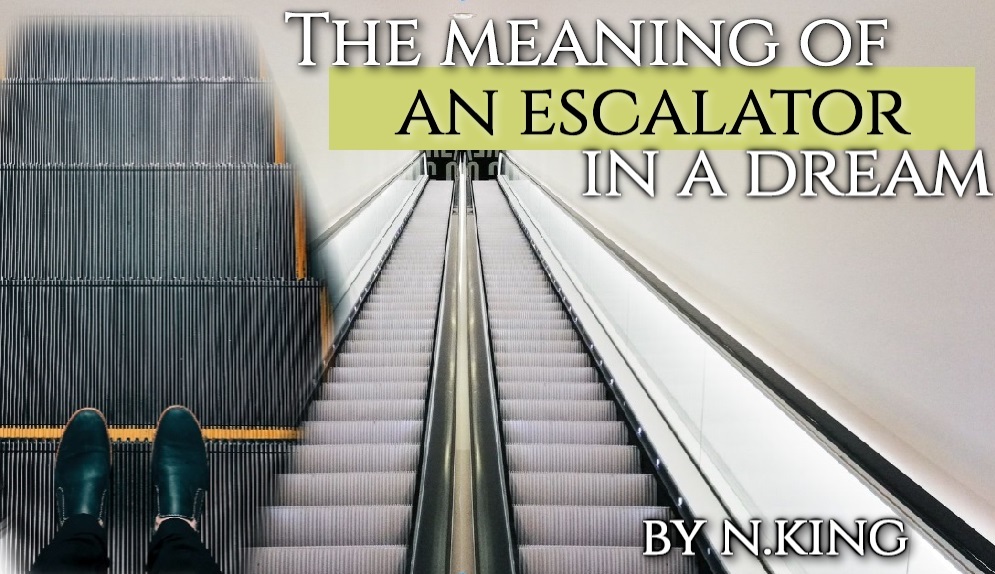
I dreamt I was trying to get up to a meeting. Not a life-or-death meeting, just a really, really important one for a project I’ve been trying to push for the last year. I was rushing, sweating, briefcase in hand. I finally spot the escalator, jump on, and about three steps up, it just… ceases. Stops humming. Locks up. The people around me just start walking off, ignoring the fact that I was basically trapped on a huge metal staircase that wouldn’t move. I panicked. I woke up genuinely freaking out, heart pounding like I’d just run a marathon.
The Initial Search Disaster: A Tech Hodgepodge
My first move, the usual practice, was to grab my phone and fire up the search engine. I typed it in fast: “Dream interpretation escalator stopped.” I clicked on the top six results. This is where I started to see the hodgepodge. It was a maintenance nightmare of useless, generic garbage:
- One site told me an escalator meant “upward progress” and a stopped one meant “a temporary setback.” No kidding, Sherlock.
- Another site, trying to be all Jungian and deep, mumbled something about relying too much on “artificial help” and needing to “take the stairs.” Sounded nice, but didn’t help me figure out my real-life problem.
- A third site just kept spamming me with ads for psychic readings. I closed that tab so fast my finger hurt.
I tried key phrase matching—”stopped,” “stuck,” “rushing,” “meeting.” None of the generic explanations landed with the heavy, sickening feeling I had in my stomach. The generic answers were all boilerplate, trying to apply a single solution to a complex, messy human problem. I felt like I was staring at a piece of software written in seven different languages, all trying to run the same simple calculation and all freezing up at the same time.
My Journey Took a Sharp Turn Off the Broken Steps
The reason I went so deep on this one specific dream—the reason the failure of the online tools made me so furious—is because that dream wasn’t just random static. It was my brain catching up to reality, and it all comes back to that project I mentioned.
For the past year, I had completely poured myself into this big work proposal. I ignored family dinners, blew off weekends, and pushed aside warnings from my friends who kept saying I was too focused. I saw this project as my own personal escalator: a sure, automated path to the next level of my career. I was so confident, I even cashed out some savings to start renting a bigger workspace just based on the promise of this thing taking off. I burned the boats.
Then, about two weeks ago, the whole thing hit a wall. Not a rejection, but a sudden, indefinite “pause.” A senior VP got sick. The funding got rerouted. All the momentum, all that smooth, upward, automated travel, just vanished. I was left holding the bag, standing there with my mouth open, literally trapped on the third step of my success plan. I had relied on the structure—the escalator—to carry me, and it had catastrophically failed.
I kept that news to myself. I didn’t want to admit to my spouse or my friends that the thing I dumped everything into was dead in the water. That dream was my subconscious mind screaming the truth I refused to speak out loud.
The Practical Fix: Shutting Down the Dictionary
The professional dream tools were worthless because they only read the symbols (escalator, meeting). They missed the feeling and the immediate context. So I changed my practice. I ditched the search engine entirely.
My new process, which is now my permanent practice, went like this:
- I grabbed a notebook—not the phone—and forced myself to write down three raw, ugly, uncensored sentences about how I felt the moment I woke up. (Result: “Terrified. Trapped. Looking stupid while everyone else walks around me.”)
- I ignored the symbols and focused only on the feelings. Trapped. Stops suddenly.
- I made a list of three real-life events from the previous 72 hours that perfectly matched those feelings. (Result: 1. That email from the VP’s assistant. 2. The landlord asking about the rent increase for the new workspace. 3. My wife asking me why I was so quiet.)
- I connected the dots. The “stopped escalator” was the visual blueprint of my massive, stalled work project. The people ignoring me were the real-world feeling that my personal crisis wasn’t a big deal to the machine of the company.
The dream wasn’t a prophecy about future failure. It was a snapshot of my current emotional panic over a failure that had already happened. The practice of connecting the raw emotion to a recent, specific, corresponding event is the only way to get a useful interpretation. I had to dismantle the automatic system, throw away the generic toolset, and start manually climbing down.
The dream didn’t tell me to quit; it told me I needed to stop waiting for the machine to restart. The real meaning was: Start walking down, find the stairs, and rebuild the momentum from the ground floor up, using your own two feet. That’s the work I’m doing now, and it’s a lot harder, but at least I know why I’m doing it.